Best overall for an off-road buggy with a shorty tray: a class-legal 2S shorty hardcase LiPo. Best for a chassis with a full-length tray: a 2S full-length hardcase LiPo. Best for a 4S-powered racing buggy: a compatible 4S hardcase LiPo. The best RC car batteries for racing in 2026 match your class, chassis, and charger—not the biggest number on the label.
- The best RC car batteries for racing match your class rules, battery tray, connector, and charger.
- Choose a 2S shorty hardcase LiPo for an off-road buggy designed around a shorty battery.
- Choose a 4S hardcase LiPo only when your race class and electronics require that configuration.
- Thercparks serves RC hobbyists and racers with a hobby shop and indoor off-road racing facility in Perris.
Start with the car you actually race. Thercparks is an RC hobby shop and indoor off-road racing facility in Perris, California; this guide ranks battery formats by their intended use rather than treating incompatible packs as interchangeable upgrades.
Why this matters
A racing battery must pass two tests before performance matters: it must be legal for your class and fit your car correctly. A pack that fails either test is the wrong purchase, regardless of its capacity or discharge rating.
For your 2026 race setup, settle those requirements before comparing labels. More voltage changes the electrical demands on the system, while more capacity often brings additional size or weight. Neither automatically makes your car better over a race.
Thercparks is best for Perris hobbyists who want an RC hobby shop and indoor off-road racing facility. Bring your chassis requirements and race-class information when discussing a battery choice.
What makes the best RC racing battery?
Use these six checks before choosing a format:
- Class legality: Confirm the permitted chemistry, cell count, charge voltage, and any approved-battery requirements.
- Physical fit: Match the tray dimensions, retaining system, terminal position, and clearance around wiring.
- Electrical compatibility: Check the motor controller's supported voltage and the correct connector and polarity.
- Race-length capacity: Choose enough capacity to finish your event without selecting a larger pack by default.
- Charger compatibility: Your charger must support the battery chemistry, cell count, connections, and charging procedure.
- Condition and care: Reject damaged packs and follow the battery manufacturer's charging, storage, and inspection instructions.
For 2026 purchases, use the current rules for the event you intend to enter. Another driver's battery choice is useful context, not proof that the same pack belongs in your car.
Best RC racing batteries at a glance
These are ranked buying formats, not a claim that one manufacturer's battery outperforms another. Each recommendation has a different job.
| Rank and battery format | Best for | Standout feature | Key limitation |
|---|---|---|---|
| 1. 2S shorty hardcase LiPo | Off-road buggies designed for shorty packs | Compact format matched to a shorty tray | Not a substitute for every full-length pack |
| 2. 2S full-length hardcase LiPo | Chassis designed for a full-length pack | Matches a longer battery compartment | Too long for a shorty-only tray |
| 3. 4S hardcase LiPo | Racing vehicles designed for a single 4S pack | Required voltage configuration for compatible systems | Incompatible with 2S-only electronics |
| 4. 1S hardcase LiPo | Pan-car classes specifying a single-cell pack | Matches single-cell racing systems | Not an off-road buggy replacement |
1. 2S shorty hardcase LiPo: best for shorty-tray off-road buggies
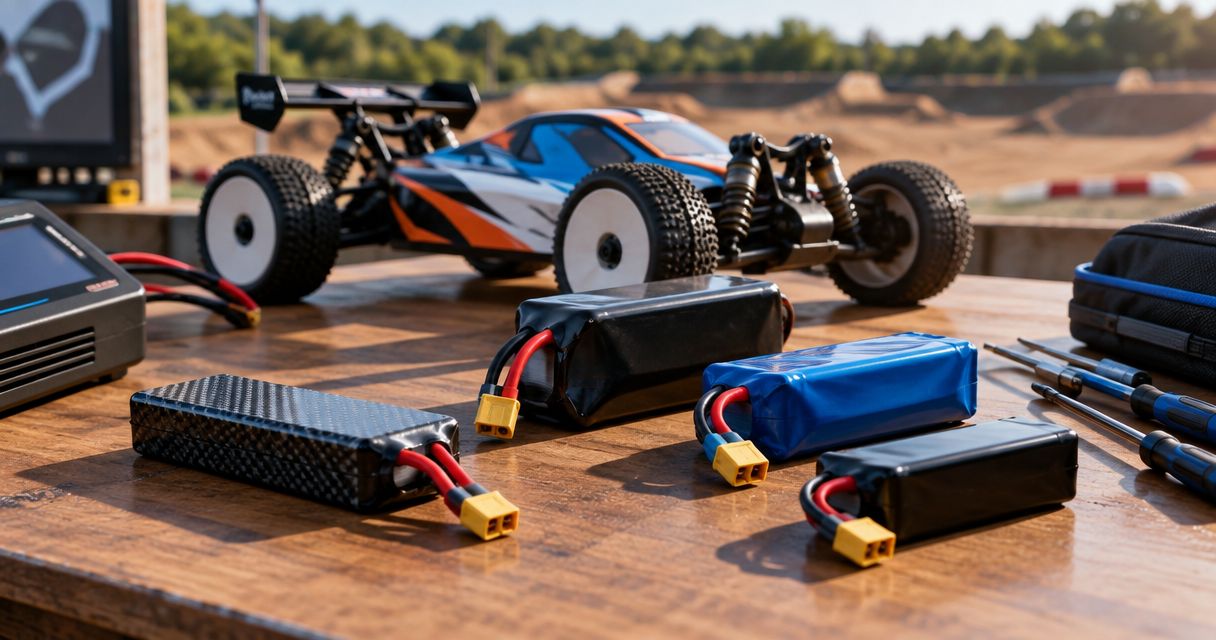
A 2S shorty hardcase LiPo is the first format to consider when your buggy's manual specifies a shorty pack. The compact case fits a battery layout built around that footprint; it is not simply a smaller version that fits every car.
A conventional 2S LiPo has a nominal voltage of 7.4 volts and reaches 8.4 volts at its standard full-charge voltage. Those figures describe conventional LiPo chemistry, not permission to use a particular pack in a particular class.
2S shorty hardcase LiPo pros:
- Matches the battery compartment in shorty-compatible buggy chassis.
- Leaves the chassis layout as intended instead of requiring improvised retention.
- Offers a focused starting point for comparing dimensions, capacity, and terminal arrangements.
2S shorty hardcase LiPo cons:
- Shorty dimensions and terminal layouts still need checking against your specific chassis.
- A compact pack does not guarantee enough usable capacity for your event.
- A hard case does not make a damaged lithium battery safe to use.
Best for: Off-road buggy racers whose chassis and class both specify a compatible 2S shorty pack.
Before choosing, inspect how the leads exit the battery compartment. A pack can fit inside the tray while its cables interfere with the body or retaining hardware. Follow the chassis manufacturer's intended installation rather than forcing the wiring into place.
Verdict: Buy a 2S shorty hardcase LiPo when your buggy is designed for it and your class permits it.
2. 2S full-length hardcase LiPo: best for full-length battery trays
A 2S full-length hardcase LiPo suits a chassis built around a longer battery compartment. Start here when the vehicle manual calls for that format, including compatible touring cars, trucks, and other racing platforms.
The cell count gives this format the same nominal voltage as a conventional 2S shorty LiPo. The important distinction is the physical package, not an automatic increase in power.
2S full-length hardcase LiPo pros:
- Matches a chassis designed around a full-length battery.
- Supports a direct comparison against the dimensions in your vehicle manual.
- Avoids assuming that a shorter pack can use the original retaining system unchanged.
2S full-length hardcase LiPo cons:
- Does not fit a shorty-only compartment.
- Greater capacity does not automatically improve handling or race results.
- Connector placement can still create clearance problems despite a correct case length.
Best for: Racers whose vehicle requires a full-length 2S battery and whose rules permit LiPo chemistry.
Check height as carefully as length. The battery must sit securely without pushing against the body, straining the leads, or requiring the hold-down to be overtightened. Compare the complete pack dimensions, not just a listing's format name.
Verdict: Buy a 2S full-length hardcase LiPo for a matching tray; skip it for a shorty-only chassis.
3. 4S hardcase LiPo: best for single-pack 4S racing systems
A 4S hardcase LiPo belongs in a vehicle whose electronics, battery compartment, and class rules support a single 4S pack. It is a configuration choice, not an upgrade for a 2S car.
A conventional 4S LiPo has a nominal voltage of 14.8 volts. That makes verifying the controller's voltage limits essential before connecting the battery.
4S hardcase LiPo pros:
- Supplies the specified cell count for a compatible single-pack 4S system.
- Keeps battery selection aligned with the vehicle's electrical requirements.
- Gives you a clear format to check against the tray and retaining hardware.
4S hardcase LiPo cons:
- Must not be connected to electronics rated only for a lower voltage.
- Requires a charger that supports the correct chemistry and cell count.
- A vehicle designed around split packs does not automatically accept one large pack.
Best for: Racers with a vehicle explicitly designed for a single 4S battery, including compatible electric eighth-scale racing platforms.
Confirm the battery layout before buying. Two separate battery compartments and one large compartment are different installations, even when the intended total cell count matches. Do not improvise series wiring or retention to make an unsuitable pack work.
Verdict: Buy a 4S hardcase LiPo only for a matching single-pack system and race class.
4. 1S hardcase LiPo: best for single-cell pan-car classes
A 1S hardcase LiPo serves racing classes built around a single lithium-polymer cell. It is included because the best racing battery depends on the discipline, not because it competes directly with off-road buggy packs.
A conventional 1S LiPo has a nominal voltage of 3.7 volts. The car's electronics and class regulations must support that single-cell arrangement.
1S hardcase LiPo pros:
- Matches the electrical format required by compatible single-cell classes.
- Keeps the battery choice specific to the racing platform.
- Provides a clear starting point for checking legal dimensions and installation.
1S hardcase LiPo cons:
- Is not a substitute for the 2S pack specified by an off-road buggy.
- Requires a compatible charging setup and connections.
- Still needs the same careful inspection and lithium-battery handling as other LiPo packs.
Best for: Pan-car racers whose class and chassis specify a 1S hardcase LiPo.
For an off-road buyer, this is an easy elimination. A battery recommended for a different racing discipline does not belong on your shortlist just because it carries a racing label.
Verdict: Buy for a specified 1S class; skip for a car requiring 2S or 4S.
Choose your battery in this order
For your 2026 setup, work through the purchase decision before comparing discharge labels. This sequence separates requirements from preferences.
- Read the rules. Establish the permitted chemistry, cell count, case requirements, and charging limits.
- Check the chassis. Record the required format and compare the battery's actual dimensions with the manual.
- Match connections. Verify the connector, polarity, terminal layout, and charger connections.
- Confirm capacity. Select enough capacity for the event, then evaluate the pack in your own car.
- Inspect condition. Check the case, leads, insulation, and connectors before charging or running.
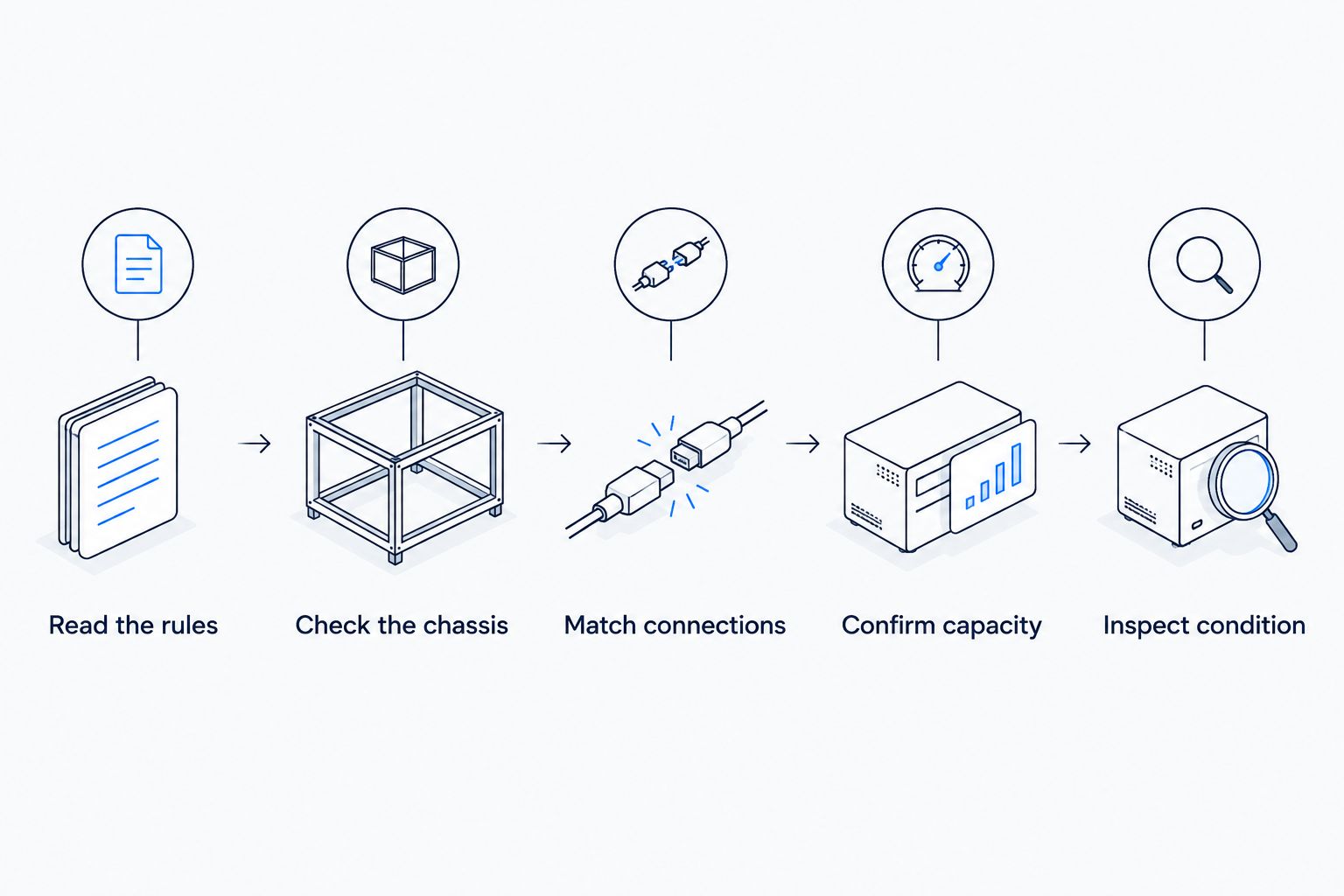
A discharge rating is not a fit check, a safety approval, or a race result. Do not let a large C-rating distract you from the requirements above, and do not assume labels alone establish a fair performance comparison between brands.
Charging and care belong in the buying decision
Choose a battery you can charge correctly with your equipment. For conventional LiPo chemistry, the standard full-charge limit is 4.2 volts per cell; LiHV batteries use different specified limits, so chemistry selection matters.
Use the charging method and limits specified by the battery and charger manufacturers. Balance-charge multi-cell packs as instructed, remain present during charging, and use the recommended fire-resistant charging arrangement away from combustible materials.
For storage, follow the manufacturer's storage-charge guidance. Stop using a pack with swelling, damage, exposed wiring, or abnormal behavior; a hard shell does not remove the risks associated with a damaged lithium battery.
How the formats are ranked
The ranking puts shorty-compatible off-road buggies first, followed by full-length 2S chassis, single-pack 4S systems, and single-cell pan cars. Each slot answers a different fit-and-class requirement.
The criteria are legality, physical fit, electrical compatibility, race-length capacity, charging compatibility, and condition. This is a 2026 buying guide by application, not a laboratory ranking of battery brands or a claim of measured lap-time gains.
Which RC racing battery should you choose?
For an off-road buggy designed around a shorty tray, start with a class-legal 2S shorty hardcase LiPo. Change that recommendation only when your chassis or class requires another configuration.
For a full-length tray, choose the matching full-length pack. For a single-pack 4S system or a 1S pan car, follow that system's requirements instead. The right battery fits your race—not somebody else's shopping list.
FAQ
What's the best RC car battery for racing in 2026?
The best RC car battery for racing matches your class rules, chassis, electronics, and charger. For an off-road buggy designed around a shorty tray, start with a permitted 2S shorty hardcase LiPo.
Is a shorty LiPo better than a full-length LiPo?
A shorty LiPo is better for a chassis designed around a shorty battery, not automatically better for every car. Match the required dimensions, retention system, and terminal clearance before comparing capacity.
Can I use a 4S battery in my 2S RC car?
Do not connect a 4S battery to electronics rated only for 2S. Follow the vehicle and controller manufacturers' voltage limits rather than treating extra cells as a simple speed upgrade.
Does a higher C-rating make an RC battery better for racing?
A higher printed C-rating alone does not establish that a battery is better for racing. Legality, fit, capacity, condition, and electrical compatibility still determine whether the pack belongs in your car.
Can I charge a LiHV battery like a normal LiPo?
Use only the charging mode and voltage limits specified for the battery and permitted by your race rules. Do not select a higher-voltage mode merely because the charger offers it.
How much capacity do I need for an RC race?
You need enough usable capacity to complete your event in your own car. Race duration, motor setup, gearing, conditions, and driving affect consumption, so there is no universal capacity recommendation.
Is a hardcase LiPo safe if the case looks damaged?
Stop using a LiPo with a damaged case and follow the manufacturer's handling and disposal guidance. Do not charge or race it simply because it still powers the car.
One last thing
Take a photo of your battery tray and existing connector before shopping. Add the chassis model and the 2026 class rules. Those details help Thercparks discuss the correct RC racing battery format without relying on a vague request for more power.